This week, my thoughts after one week with the iPhone Duo, plus new Macs, one TRULY new Mac, and a disappointing iPad mini
AskPHT: Instant iPhone Support
Inside my iPhone Essentials Plus course, you get full access to Ask PHT, my built-in AI assistant designed to save you hours of frustration. Instead of hunting through menus or searching over 400 lessons, just ask a question in plain English. You don't even need to know the right Apple terminology.
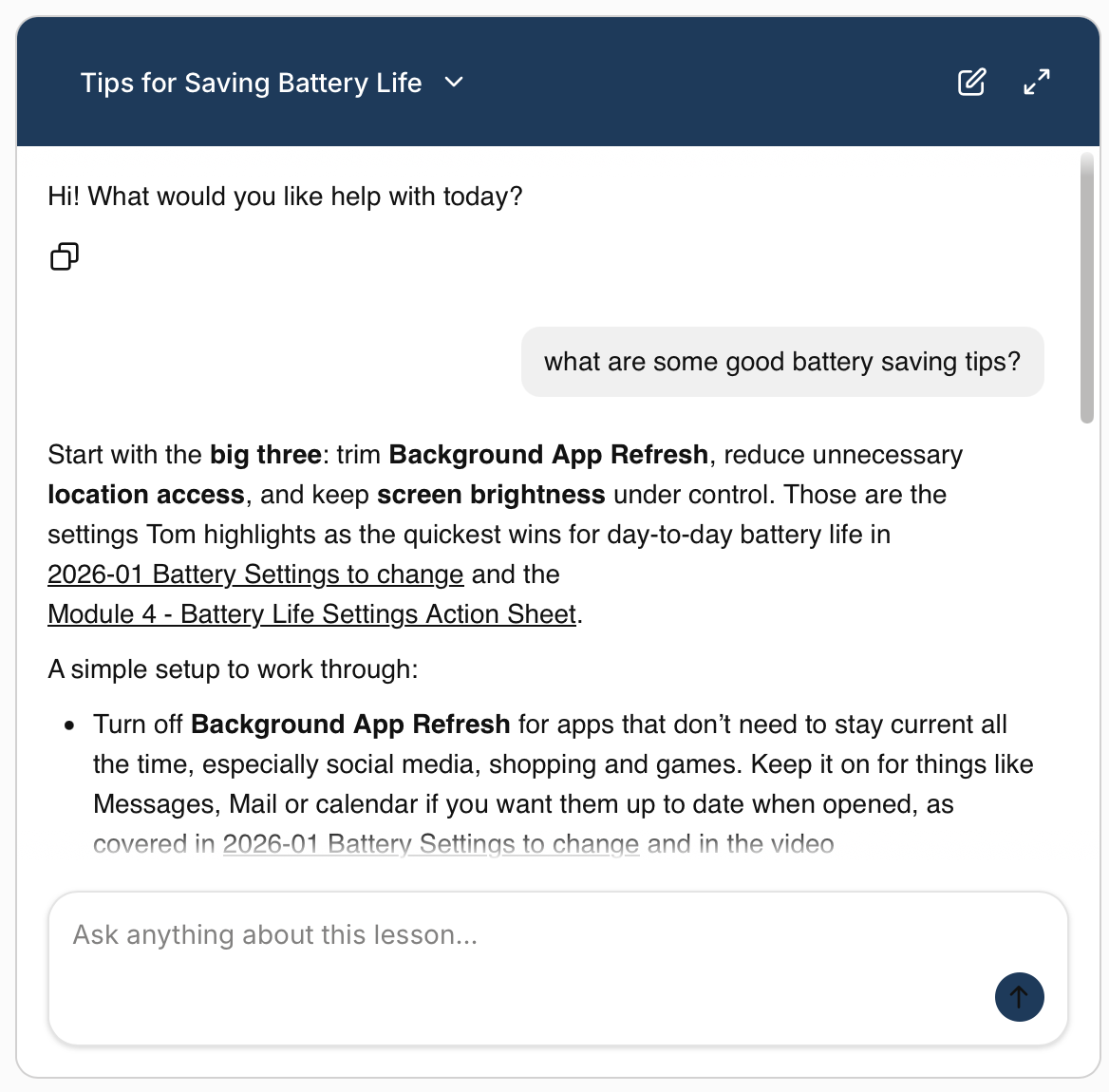
Whether you want to customise notifications, master CarPlay or get a five-minute tap-by-tap security checklist, Ask PHT gives you an immediate answer and links straight to the exact video walkthrough you need. Unlike ChatGPT or Gemini, which pull from random corners of the internet, Ask PHT is trained directly on my trusted course material so you get reliable, tested advice every time.
If you already own iPhone Essentials Plus, log in here and put it to the test.
If you haven't joined yet, grab iPhone Essentials Plus at its current price today and you'll also get my upcoming beginner course, iPhone Essentials, completely free when it launches soon.
Purchase Links;
One Week With the Duo
I've had the iPhone Duo for a week now. I picked it up from the Apple Store last Friday morning, and I've used it as my only phone every day since, so I wanted to start the newsletter this week with my thoughts, one week in.

It isn't perfect. But it is, without question, the most enjoyable Apple product I've used in years. I wrote last week about how stale iPhone upgrades have become, each one a slightly better version of the last with little to get excited about. The Duo is the first time in a very long time that Apple has gone out of its way to make something completely different, and the thing that surprises me most is that it doesn't feel like a foldable made for the sake of having a foldable. It feels like an iPhone that happens to fold. Apple has built what's essentially a new branch of iOS for this device, and you never get the sense that you're trying to make the normal iPhone software work on hardware it wasn't designed for. Everything just fits.
I've had multiple moments of genuine joy with it already, and I want to share two, because they explain better than any spec sheet why this thing works.
The first was a FaceTime call with my sister, who lives in London. There's a big building site opposite her flat, and my little boy, one of my three-year-old twins, is obsessed with construction sites. So she flipped to her rear camera to show him the diggers. Here's what happened on my end. I had the Duo in my hand, unfolded, with DuoFaceTime running. On the inner screen I could see both her camera feed, the construction site, and my own rear camera feed, the kids sitting opposite me, so I could see exactly what she was seeing and aim my camera accordingly. On the outer screen, facing the kids, was her feed of the building site, so they could watch the diggers. My wife and I could see everything. The kids could see everything. My sister could see everything. Nobody was craning round a screen or passing a phone back and forth. It just worked the way it was supposed to, and that's exactly what Apple gets right when it gets things right.
The second was more mundane, and somehow just as satisfying. My business manager emailed me a contract to sign. I opened it on the folded Duo, saw a PDF that was far too small to read, unfolded the phone, turned it to portrait, and suddenly I was looking at an iPad-sized document I could scroll through, read properly, and sign at the bottom. Folded phone to signed contract in less than ten seconds. No laptop. No iPad. No zooming and squinting.
Battery life has been excellent. I've got nothing negative to say about it. The only genuine downside is the weight and thickness when it's closed, which is the inevitable trade-off of the design. Unfolded, it's remarkably thin, like holding a large iPhone Air. Folded, it's like holding two iPhone Airs stacked on top of each other, and it's big. What I didn't expect is how much I use it folded anyway. The outer screen is more than good enough for messages, quick checks, and most of what I do during the day, and I only open it when I actually want the bigger display. It's not a tablet you have to open every time. It's a phone with a bonus.

One practical tip. The inner display has Apple's nano-texture anti-glare coating, and fingerprints on it do not come off with a baby wipe or a regular microfibre cloth (speaking from experience here). Neither lifted a single mark, to the point where I started to worry I'd damaged it. So I went on Apple's website and ordered three of their new polishing cloths, which are about £9 each in the UK. They lifted everything immediately. It pains me slightly that Apple has figured out the cleaning cloth as well as the phone, but buy one when you buy the Duo. You'll need it.
The crack situation
I can't write about the Duo this week without addressing the screen cracks, so let's do it properly.
Within hours of launch, reports started appearing of inner displays cracking along the hinge, all in a similar spot about a third of the way up the right side. Gurman at Bloomberg spoke to a dozen owners who described the hinge suddenly feeling stiff, a crunching sound, then a crack and bright lines across the display. iFixit's teardown suggests the centre bar of the hinge may not be dropping low enough as the phone closes, pressing against the panel from underneath. Apple confirmed the issue on Monday, calling it a "small number of units," and said affected customers should contact AppleCare for a replacement.
There are two sides to this, and both are true. For the people it's happened to, it's a terrible experience. You spend £2,000 on a phone, you open it, it breaks. That's bad. And it's made worse by the supply situation. In a normal launch, you'd walk into an Apple Store and walk out with a new one. Right now, a lot of stores don't have stock, so people are being turned away with a broken phone and no immediate fix. That's genuinely poor, and Apple needs to sort it fast.
But I also don't see the evidence for the narrative Gurman has been pushing, which is that Apple has botched the launch. Every new product has teething problems. We knew months ago that Apple was rejecting a surprising proportion of the initial production run for quality issues, and the most likely explanation here is that some units got through that shouldn't have. Apple's own statement says most phones won't be affected and that the fault shows up almost immediately after first opening, which fits. If you've had yours for a week with no problems, as I have, you're almost certainly fine. That's not me dismissing the people affected. It's me saying this looks like a defective batch, not a defective product.

I was disappointed by iJustine's contribution, though. I quite like her. I don't think of her as a tech reviewer, more a hype person that brands hire who makes entertaining videos, and I enjoy her sass on social media. But her tweet this week, "my iPhone Duo has been working great because I have not actively tried to break it," felt a bit gaslighty. The people whose screens cracked weren't trying to break them either. And Apple needs to be very careful not to go anywhere near its Antennagate response, where the fix was essentially to tell customers they were holding it wrong. When this phone was first shown to the press, I watched reviewers flicking it open one-handed like a Zippo. I haven't done that with mine, because I respect it too much, but that kind of handling is exactly what the hinge should be tested against. If it can't survive a tech YouTuber being a bit casual with it, that's a design problem, not a user problem.
The apps
Last week I said the complaints from reviewers about app optimisation were lazy, and I stand by that. A week on, I've had around fifty apps updated with Duo support on my phone, with more landing every day. The "nothing works on it" narrative was overblown at launch and it's being resolved quickly. There are still gaps, and some of them are Apple's own. The Apple Store app, remarkably, still isn't optimised for the Duo. Someone replying to a post on X this week said Steve Jobs would have taken a bullwhip to the engineering team over that one, which made me laugh, but they've got a point. If it's as easy for developers to update as Apple says, then every Apple app should have been ready on day one. That's basic housekeeping.
The realisation
Here's the thing I didn't expect. A couple of weeks ago I wrote that I'd buy the new iPad mini on the spot if it had ProMotion. It doesn't, so I'm not. But I realised this week that the Duo is my iPad mini now. And it's better than an iPad mini could ever be, because it runs iOS rather than iPadOS. My banking apps, the ones that have never bothered with a proper iPad version, run perfectly on it. Everything I've ever used on my phone runs on it, because it is my phone. It's the exact combination of iPad mini and iPhone I've wanted for a decade, in one device. I'll keep the iPad Pro for proper work. But the mini, even with ProMotion, wouldn't have made sense for me any more. In a strange way, Apple putting a 60Hz screen on the iPad mini saved me £699.
Everyone's going to feel differently about this phone. Some people will love it, some won't, and the compromises I wrote about before launch are all still there. But if you've got a pre-order in, you've been reading the negative headlines, and you're starting to wonder whether you've made a mistake: you haven't. If you're excited about the form factor and you're happy to learn a slightly new way of using your phone, I think you're going to love it. I certainly do.
New (not new) Macs
Apple announced two new Macs on Monday, and if you've seen either of them before, you've seen them now. The 24-inch iMac and the 14-inch MacBook Pro both get Apple's M6 chip, the 2nm silicon that debuted in the Mac mini back in August. Nothing else changes. Same designs, same displays, same colours, same ports. Pre-orders opened on Wednesday, and both ship on Friday November 6.
Here's what you're getting. The M6 has a 12-core CPU and a 12-core GPU, up from 10 and 10 on the M5, and Apple says it delivers up to 30% faster graphics and 25% faster AI workloads than the chip it replaces. Both machines pick up Wi-Fi 7 and Bluetooth 6 via Apple's N1 wireless chip. The MacBook Pro keeps its 24-hour battery and adds fast charging, 50% in 30 minutes with a suitable adapter. The iMac comes in two configurations: a 10-core version with two Thunderbolt ports at £1,499/$1,499, or the full 12-core chip with four Thunderbolt ports at £1,699/$1,699. The MacBook Pro is £1,999/$1,999 with 16GB of memory and 1TB of storage, in space black or silver.
Those prices are the same as they were last week, which is the first time in months I've been able to write that sentence. They're also the prices Apple set during the June increases, so the MacBook Pro is still $400 dearer than the M5 model was at launch and the iMac still $200 above where the M4 landed in 2024. No new hike, but no reprieve either.
For the iMac, this is good news. The previous model was two years old, and if you've been eyeing one up, you now get a meaningfully more capable chip for the same money. That's a straightforward recommendation. Nothing about the iMac needed changing, so Apple didn't change it.
The MacBook Pro is where things get strange, and it's worth spelling out, because the lineup Apple is now selling makes very little sense on paper.
If you buy a MacBook Pro today, your entry-level option is the M6. One generation ahead. Brand new. But if you want the professional-grade silicon, the M5 Pro or M5 Max with more cores, more memory, and more bandwidth, you have to step back a generation. The Pro and Max chips are still M5. And according to everything Gurman has reported, there isn't going to be an M6 Pro or M6 Max at all. Apple is skipping them entirely and jumping to M7 Pro and M7 Max next year.
So the "best" chip in the MacBook Pro range is technically older than the "entry-level" chip. The base model has the newest silicon and the worst specs. It's a lineup where the generation number tells you almost nothing about which machine is faster, and where a buyer trying to make sense of it has to understand Apple's chip roadmap better than most Apple employees probably do. If you're a student or a business user who wants a very good laptop, the M6 is the right call. If you're doing serious creative work, you want the M5 Pro or Max, and you'll be buying those in the new OLED chassis Apple showed off on Wednesday. If you want the M7 Pro, you're waiting until 2027.
None of that makes these bad machines. The M6 iMac in particular is an easy buy for anyone who wanted one already. But what a weird place for Apple to be in: a brand new chip at the bottom of the range, last year's chip at the top, and nothing in between until next year.
iPad mini: So Close, Yet So Far
Apple announced the new iPad mini on Monday, and I want to start with everything that's good about it, because there's a lot. Then I want to tell you why I'm not buying one, and why that frustrates me more than any Apple decision this year.

The headline is the display. For the first time, the iPad mini gets OLED: an 8.5-inch panel, up from 8.3 inches thanks to slimmer bezels, with 1,200 nits peak brightness, a 2,000,000:1 contrast ratio, and the option of Apple's nano-texture anti-glare coating. It's the first OLED on any iPad outside the Pro. It runs the A20 Pro, the same chip as the iPhone 18 Pro and the Duo, which Apple says is up to 60% faster than the previous mini for everyday tasks and 4.5 times faster for AI. It's 15% thinner and lighter. It's IP67 water resistant, a first for any iPad. The front camera finally moves to the landscape edge. There's a new Acoustic Display speaker system with no visible speaker holes. It supports the Apple Pencil Pro. And it gets Wi-Fi 7, Bluetooth 6, and Apple's own C2 modem on cellular models.
It costs £699/$699 for 128GB Wi-Fi, which is £100 more than the previous model and £200 more than that model cost when it launched in 2024. The colour range has shrunk from four to two: midnight and starlight. Pre-orders opened on Wednesday and it ships on November 6.
And it's 60Hz.
Apple's spec sheet doesn't mention ProMotion. It doesn't mention a refresh rate at all, which is the giveaway. If it were 120Hz, that would be on the page in big letters. It isn't. So the first OLED iPad mini, at £699, has the same refresh rate as the iPad mini I bought more than a decade ago.
I need to explain why this matters so much to me. I've been an iPad mini person since the very first one. I bought it the week it came out, back when it was essentially the iPad 2 shrunk down, and I adored it. It was everything I wanted an iPad to be: genuinely portable, one-handed, something you could throw in a coat pocket, but still a proper iPad. Over the years I've watched Apple quietly pick it apart. Features that landed on the bigger iPads skipped the mini. The chip lagged. The screen lagged. It stopped feeling like the main product in a smaller body and started feeling like the afterthought. Because of what I do for a living, I drifted to the iPad Pro, and the M4 iPad Pro I have now is a stunning machine. But even the 11-inch is big. If I'm on the sofa and I just want to read something, it's too much device. The mini was always supposed to be the answer to that, and Apple has spent years making sure it wasn't.
So when the OLED rumours started, I let myself hope. I said in this newsletter a couple of weeks ago that if Apple gave us OLED with ProMotion, I'd buy one the moment it was announced. Even with a Duo in my pocket. Even at a higher price. I would have paid an extra £100 or £200 for a mini with a 120Hz panel, and I don't think I'm alone. The internet has been asking for a Pro iPad mini for years. Loudly. And Apple's answer, after all that waiting, is an OLED screen that stutters when you scroll.
In 2026, at £699, a 60Hz display is hard to defend. Every iPhone Apple sells above the 17e has ProMotion. Every iPad Pro has had it since 2017. The mini is now the only OLED device Apple makes without it, on a product whose entire point is reading, browsing, and scrolling. It's not a technical limitation. It's a choice. And the choice tells me Apple either doesn't understand who buys this thing, or doesn't care.
Here's the uncomfortable part. A bit of me hopes it doesn't sell. Not because I want the product line to die, the opposite. I want Apple to look at the numbers and realise that the people who love the iPad mini would happily pay more for the full experience, and that what we're being offered isn't it. The OLED screen, the A20 Pro, the water resistance, the Pencil Pro support, all of that is genuinely great. If you've got your heart set on a mini and you've never been bothered by 60Hz, this is comfortably the best one Apple has ever made and you should buy it. But for me, and I suspect for a lot of the people who've been waiting longest, it's one spec short of the device we actually asked for.
Swing and a miss. Again.
The (PROLED) MacBook Pro
On Wednesday, Apple closed out its busiest October in years with the one everyone was waiting for. It's called, and I apologise in advance, the MacBook Pro with PROLED XDR Display. The first redesign of the MacBook Pro since 2021, the first OLED on a Mac, and, after years of Apple insisting it would never happen, the first touchscreen Mac. Pre-orders opened the same day. It ships November 6.

The price first, because it frames everything. The 14-inch with M5 Pro starts at £2,899/$2,899. The 16-inch at £3,399/$3,399. The M5 Max versions are £4,499 and £4,799. Every touch model is exactly £400 more than the equivalent non-touch MacBook Pro from March, which Apple is still selling. And if you tick every box on a 16-inch, 128GB of memory and 16TB of storage, it comes to £14,549/$14,549. The most expensive MacBook Pro at launch in the product's history.
What you get: a tandem OLED display with 2,000 nits of brightness, a 10,000,000:1 contrast ratio, and 120Hz. The notch is gone, replaced by a Dynamic Island. The glowing Apple logo on the lid is back. The 14-inch weighs 3 pounds, down from 3.4, and the 16-inch is 4 pounds. There's a six-speaker array with a new woofer, three Thunderbolt 5 ports, HDMI, an SD slot, MagSafe, and a headphone jack. And macOS now translates taps into clicks, so existing apps work with touch without developers having to do anything. The chips are the same M5 Pro and M5 Max from March, which, as I wrote above, leaves the lineup in a strange spot where the most expensive Mac laptop runs last year's silicon and the cheapest runs this year's.
My situation
I should be honest about where I'm starting from, because it shapes everything that follows. I'm not in the market for a new Mac. My main machines are an M2 Ultra Mac Studio and an M3 Max MacBook Pro, and both do what I need flawlessly. I put out a 22-minute video this week about iPhone theft, a fairly complicated timeline with effects and colour grading, and when I hit export on the Studio I went to make a coffee. By the time I got back, it was done. It takes longer to upload a video to YouTube than it does to render it. The MacBook Pro is nearly as quick on the rare occasions I render on it; the only difference is the fans kick in. So neither computer is holding me back, and there's no gap in my workflow that a new one would fill.
I said with the iPad mini that I was prepared to be persuaded, and the same was true here. And in one specific way, I have been.
The only thing I genuinely dislike about my setup is what happens when I want to leave the office. If I'm sitting at my desk with my two Studio Display XDRs and decide to go and work in the kitchen or a café, I have to copy files from one machine to the other. It's a small friction. And there's a part of me that would quite like to sell both the Studio and the MacBook Pro and replace them with a single top-spec laptop that's my desktop when it's docked and my laptop when it isn't. One machine, one set of files, one cable, no copying. A third beautiful screen sitting next to the two XDRs would be a nice bonus.
If I go down that route, and I genuinely don't know whether I will, or whether I'll wait for the M7 chips, this MacBook Pro is absolutely the one. There's a lot to like.
What works
The display is the headline, and from what I've seen it deserves to be. When Apple gets a display right, it really gets it right, and everything from the press hands-ons suggests this is one of those. Two thousand nits, true blacks, 120Hz. That alone is probably enough to justify the purchase for a lot of people. I think "PROLED" is a slightly corny name, but that's Apple being Apple.
I like the Dynamic Island far more than I expected to. It's a much better solution than the notch and it makes the whole top of the screen feel considered rather than compromised. The glowing logo is lovely, and let's be honest about what it's for: it's a flex. It's the thing that makes someone in a café glance over and think "oh, that's the new one." No harm in that.
Weight matters more than it sounds. Dave2D, whose opinions on laptops I trust about as much as anyone's, thinks the weight reduction is going to be a bigger deal than the touchscreen for most buyers, and I think he's right. If you carry a MacBook Pro around all day and find it cumbersome, getting this much power and this display in something lighter is a genuine improvement, even if it's only half a pound.
What I'm not sold on
The touchscreen. I'm just not convinced, at all.
Steve Jobs said touch doesn't belong on a Mac, and on the whole I agree with him. The very first image I saw from Apple's launch was someone playing a piano keyboard on screen in Logic Pro. Yes, there will be moments where a producer wants to tap in a few notes quickly. Fine. But the idea that an on-screen keyboard replaces a real MIDI controller for anyone who takes their music seriously is ridiculous. Most of Apple's touch examples felt like that: things you technically can do, not things you'd want to.
Where I think Apple might win is if you accept that touch isn't meant to be the primary interface. The keyboard, the trackpad, the mouse, those remain how almost everyone will use this machine, and I don't see that changing. Touch as an occasional extra, when it happens to be convenient, is fine. It just isn't a reason to buy the laptop, and I suspect Apple knows that, which is why the display is doing all the heavy lifting in the marketing.
Then there's the hinge. For the best part of a year, the rumour mill said Apple was engineering a reinforced hinge so the display would stay rock solid when you prodded it, which is the single biggest practical problem with touchscreen laptops. If Apple had cracked that, it would have been a headline. Instead, the press release gives it one sentence, buried at the end of a paragraph: "a newly designed hinge provides greater stability while using Touch." No detail, no engineering story, nothing in Srouji's quote. For a company that will happily spend three paragraphs on pixel layers, that silence is telling. And in the hands-on videos from the press event, you can see the display wobbling when people touch it. Some creators are saying the reinforced hinge is in there. I don't think it is, or at least not in the form everyone expected.
The comments under every one of those videos are full of the same sentence: "I've never once wanted to touch my MacBook screen." I'm in that camp. And then there are the fingerprints. MKBHD mentioned Apple has treated the display to reduce smudging, and in fairness, the demo units had been pawed by hundreds of journalists. But even allowing for that, they looked grubby. If I bought one, I'd touch the screen once to prove to myself that it works, and then I'm fairly sure I'd never do it again.
There's a bigger structural issue too. Apple is pitching this at creative professionals, and most creative professionals who take their work seriously don't do the bulk of it on a laptop screen. They use the laptop when they're away from their desk, and at their desk it's plugged into an external display. That's where the real work happens. You can't drag Photoshop or Logic onto a Studio Display and start touching that. So the feature Apple has spent the most effort explaining is one that disappears the moment you sit down to work properly.
None of that makes it a bad laptop. Touch doesn't hurt anything. The Mac isn't worse for having it. I'd just argue it isn't any better either.
The real question
Dave2D made another point this week that I think is the important one. Apple's problem isn't making great laptops. It's convincing people to upgrade. I'm the perfect example. My M3 Max is more than capable for everything I do, so why would I switch? A lot of MacBook Pro owners are in exactly the same position, and no amount of OLED or touch changes the fact that the machine they already own isn't slowing them down.
So I'll be watching what this does for sales with real interest. If the display and the weight pull people off two- and three-year-old MacBook Pros, Apple will have cracked something. If it turns out that even a screen this good isn't enough to shift people who don't need shifting, that tells Apple something about the ceiling for laptop upgrades in 2026.
Either way, it's the best MacBook Pro Apple has made. It's just not one I need yet.
Tip of the Week
Did you know, if you own an iPhone Duo, you can enable or disable a setting that allows you to fix the position of the volume controls on the side of the device, useful if you often rotate it while holding it. Head into Settings, then Sounds & Haptics to access this.