This week, the MacBook Neo is selling better than anyone expected, and Apple is allegedly pushing ahead with some exciting new AirPods.
The MacBook Neo is eating Apple alive
The MacBook Neo continues to be one of Apple's most surprising success stories, but that success is starting to cause problems elsewhere. Analyst Tim Culpan reported this week that Apple has ordered TSMC to produce a fresh batch of A18 Pro chips specifically to keep up with demand for the Neo, having essentially run out of the originals.
Here's the backstory, because it's a clever bit of supply chain engineering that's now come back to bite. When Apple designed the MacBook Neo, one of the ways it got the price down to $599/£599 was by using leftover A18 Pro chips that were originally manufactured for the iPhone 16 Pro. During chip production, not every chip comes off the line perfectly. Some end up with a faulty GPU core, which means they can't be used in an iPhone that promises a six-core GPU. Rather than throwing them away, Apple disabled the dodgy core and stockpiled the five-core versions. Those "binned" chips were essentially free inventory, and they became the heart of the MacBook Neo.
The plan was to build around 5 to 6 million units using that stockpile. The problem is that the Neo has been such a hit that Apple has now doubled its production target to 10 million units, and the bin is running dry. That means Apple needs TSMC to fire up a fresh production run of A18 Pro chips, which obviously costs real money, unlike the leftovers that were already sitting in a warehouse. Culpan suggests Apple may respond by discontinuing the $599/£599 base model with 256GB storage and keeping only the $699/£699 512GB version, which has healthier margins to absorb the higher chip costs.
If that sounds familiar, it's because Apple has already done exactly this with the Mac mini. The $599/£599 base model with 256GB storage was quietly removed from Apple's website last week, and the Mac mini now starts at $799/£799. It's not a price increase on the 512GB model itself, but it does raise the floor. Multiple higher-spec configurations with 32GB and 64GB of RAM are listed as "currently unavailable," with no option to even place an order. The Mac Studio is in a similar state. The 512GB RAM option has been removed entirely, the 256GB configuration is gone, and what's left is either backordered by months or simply not available.
Tim Cook addressed this directly during Apple's Q2 earnings call last week, saying that both the Mac mini and Mac Studio "may take several months to reach supply-demand balance." He attributed the shortages to customers adopting AI and agentic tools faster than Apple had anticipated, which has driven demand for these compact desktops well beyond forecasts. But the bigger issue is the global RAM shortage. Demand for memory from AI data centres is so intense that it's squeezing supply for everything else, and Apple, despite being one of the world's largest chip buyers, isn't immune.
It's a strange moment. Apple has a laptop that's selling faster than it can make it, two desktop Macs that it literally can't keep in stock, and a global component shortage that's forcing it to cut SKUs and raise entry prices. For customers, it's frustrating. If you're in the market for a Mac mini or Mac Studio right now, your options are genuinely limited, and have been for weeks. For Apple, it's the dictionary definition of a good problem to have, but it's still a problem, and one that doesn't look like it's going away any time soon.
You watch the videos? But how much do you remember?
If you're anything like most of my audience, you've probably watched dozens of iPhone tips videos over the years. Maybe even hundreds. You've bookmarked a few, saved some to Watch Later, maybe even scribbled a note or two. But when you actually need that tip, when you're standing there trying to remember how to do that thing you definitely saw in a video once, it's gone. You can't remember which video it was in, what it was called, or whether it was even on my channel or someone else's.
That's not a you problem. That's a content problem. YouTube is brilliant for discovery, but it's terrible for reference. Tips get buried in ten-minute videos, mixed in with ads and sponsor reads, and once you've scrolled past them, they're effectively lost. You'd have to rewatch the entire video just to find the one thing you needed.
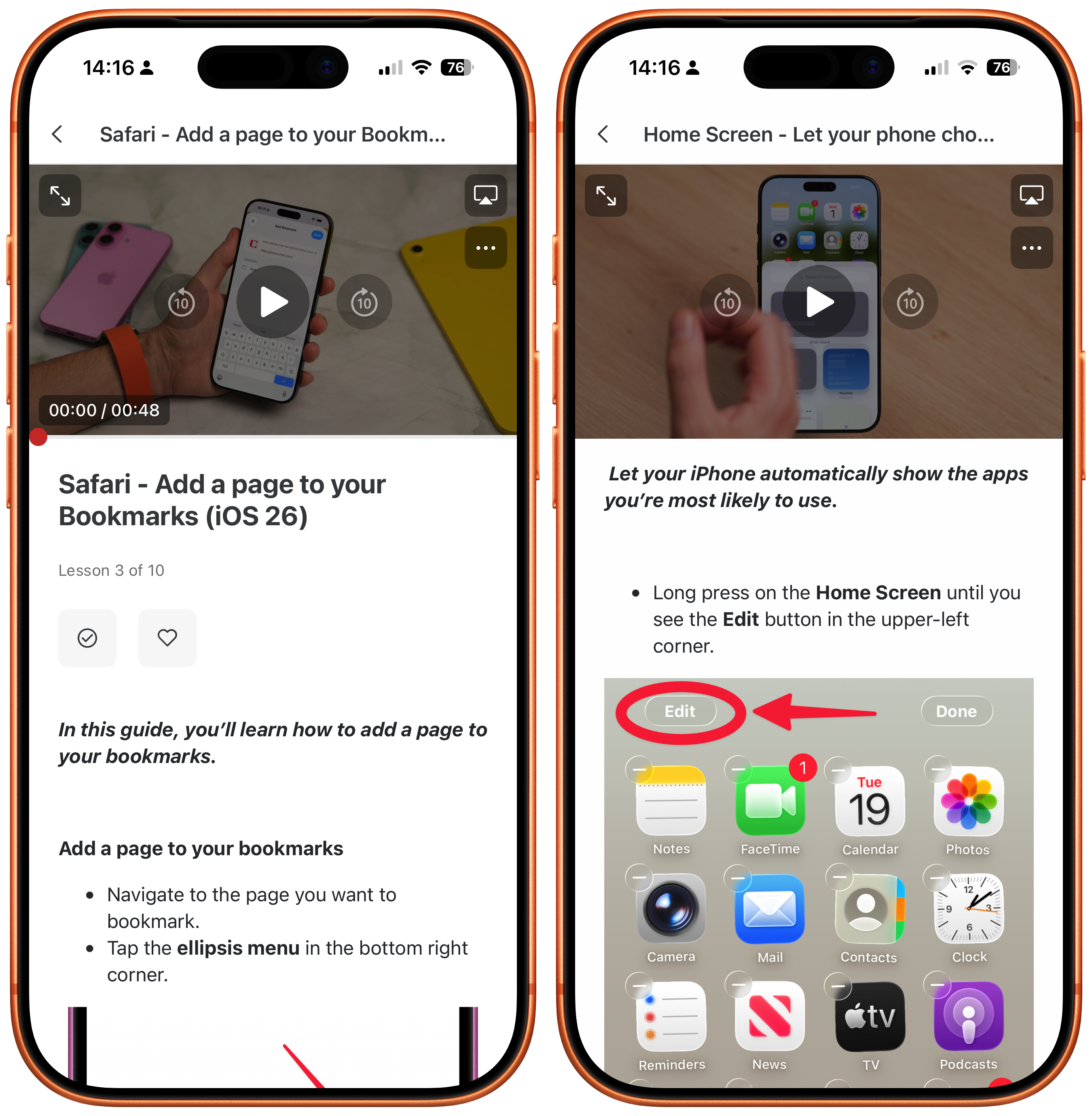
iPhone Essentials Plus was built to solve exactly this. It's not another set of videos to watch and forget. It's a structured, searchable library of over 250 lessons (and growing), each one focused on a single topic, with a video walkthrough, a written step-by-step guide, and a downloadable PDF you can keep. The tips you've half-remembered from a YouTube video, organised and accessible whenever you need it.
The course is updated regularly as Apple releases new features, so it stays current with your phone. I've also recently added ad-free, sponsor-free versions of my YouTube videos as bonus content, plus a brand new standalone course called iPhone Battery Made Easy is now included at no extra cost.
It's a one-time purchase, no subscription, with lifetime access. If you've ever thought "I know I saw a tip for this somewhere," this is the answer.
Purchase Links;
- iPhone Battery Made Easy
- iPhone Essentials Plus
- Mac Essentials Plus
- iPhone & Mac Essentials Plus Discount Bundle
AirPods with eyes?
Bloomberg's Mark Gurman reported this week that Apple's camera-equipped AirPods have reached an "advanced" testing stage, with prototypes now featuring a near-final design and feature set. The project has entered what Apple internally calls design validation testing, or DVT, which is the second-to-last stage before production begins. In plain English: these are close.
So what are we actually talking about? These aren't AirPods that take photos. The cameras are small, low-resolution infrared sensors built into both earbuds, and their sole purpose is to act as eyes for Siri. The idea is that you could look at something, a restaurant menu, a food label, a street sign, and ask Siri about it without ever pulling your phone out of your pocket. Think of it as Visual Intelligence, the feature Apple already offers through the iPhone camera, but always available because the cameras are sitting in your ears and pointing at whatever you're facing.
Gurman says Apple has also been exploring other uses. The cameras could trigger reminders based on what they see, or provide more detailed turn-by-turn directions by understanding your physical surroundings. A small LED on each earbud will light up when visual data is being sent to the cloud, which is a sensible privacy signal. The design reportedly looks similar to the current AirPods Pro 3, just with slightly longer stems to accommodate the camera hardware.
In terms of timing, Apple apparently wanted these out in the first half of this year, but they've been held back by the same thing that's been holding back half of Apple's product roadmap: the new Siri isn't ready yet. Without the revamped, more conversational Siri that's expected to arrive with iOS 27, camera-equipped AirPods don't have much to offer beyond what your iPhone can already do. The launch is now expected later this year at the earliest, possibly alongside or shortly after the iPhone 18 Pro in September. Pricing is expected to sit above the current AirPods Pro 3 at $249/£249, with Gurman suggesting Apple may use "AirPods Ultra" branding to differentiate them.
What makes this interesting beyond the product itself is what it signals about where Apple is heading. Between the smart glasses we've discussed in previous newsletters, these camera-equipped AirPods, and reports of an Apple Intelligence pendant also in development, there's a clear pattern forming. Apple is building an ecosystem of AI wearables that can see, hear, and understand your environment without you ever needing to look at a screen. If Siri delivers on its promises, the combination of smart glasses for visual AI, AirPods for audio AI, and the iPhone as the processing hub in your pocket could be genuinely compelling.
That's a big "if," of course. But unlike the Vision Pro, which asked people to strap a heavy headset to their face for $3,500/£3,500, camera-equipped AirPods are something millions of people would buy without thinking twice. Most AirPods owners already wear them for hours a day. Adding a small camera that makes Siri actually useful in the real world is a much easier sell than anything Apple has attempted in the wearable space so far.
The key, as always, is Siri. If the revamped version delivers, these AirPods could be the first Apple product where AI genuinely changes how you interact with the world around you. If Siri disappoints again, they're just AirPods with a camera nobody asked for.
Tip of the week
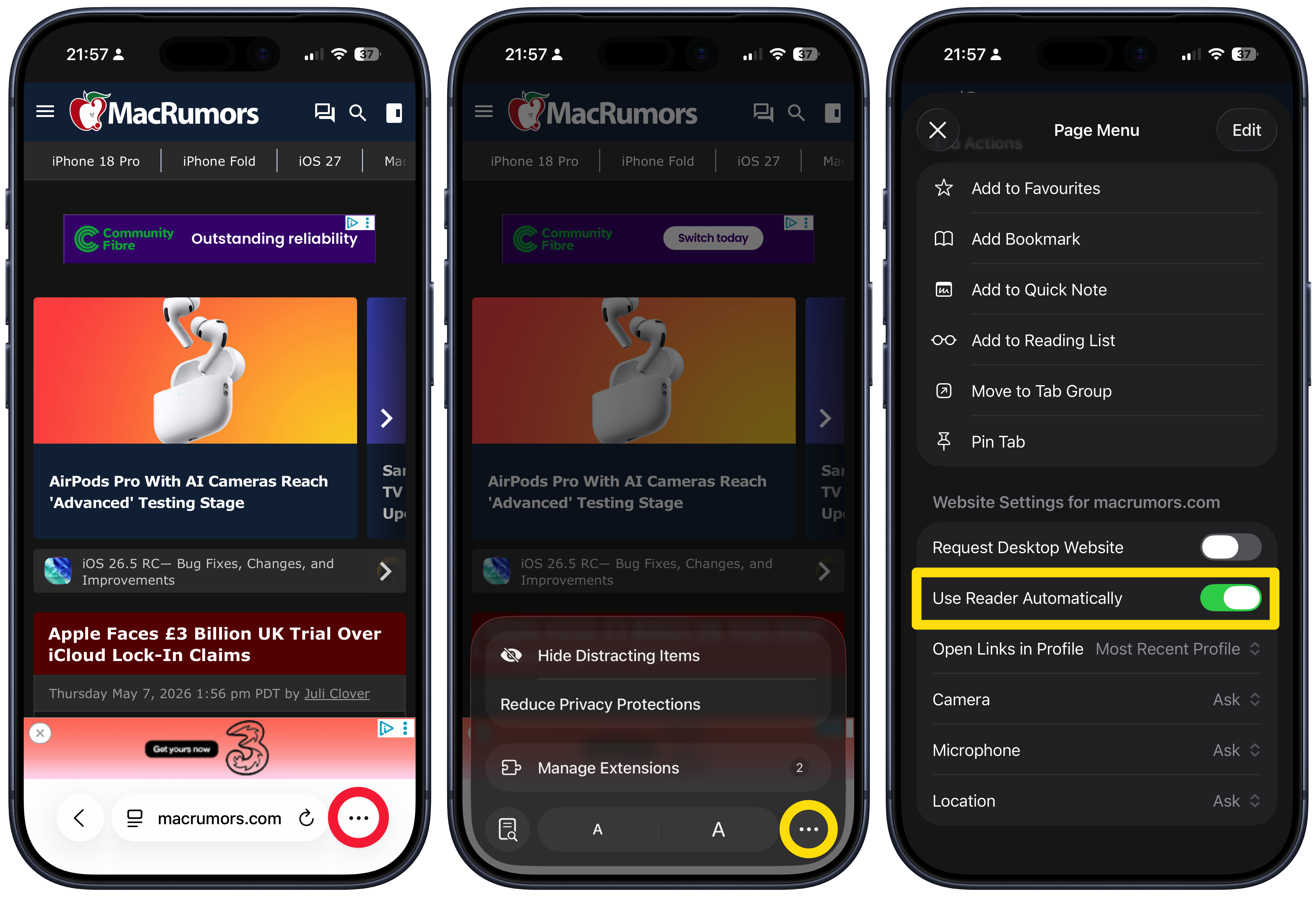
Did you know, if you have a particular website that you know you always like to view using Reader mode, you can set this to happen automatically? Tap the ellipsis in the bottom right corner, then tap the same button on the next page. Scroll down to the Website Settings section, and enable Use Reader Automatically.