This week, yet more Siri delays, Apple's product roadmap takes a detour, and iOS 26.3 is released.
So, about that new Siri...
If you've been reading this newsletter for any length of time, you'll know that I've spent the best part of a year expressing my frustration at the state of Siri. I've written about the delays, the broken promises, the growing gap between Apple and its competitors, and the nagging feeling that we're always being told the good stuff is just around the corner. So when Mark Gurman's latest report landed earlier this week, my reaction wasn't shock. It was something closer to sheer exhaustion.

According to Gurman's reporting at Bloomberg, Apple's long-awaited Siri overhaul has hit fresh problems during internal testing. The plan was for the major upgrades to arrive with iOS 26.4 in March or April, but Apple is now looking at spreading features across iOS 26.5 in May and potentially even iOS 27 in September. The situation is described as "fluid," which in Apple-speak usually means things are not going well behind the scenes and nobody wants to commit to a firm timeline.
The specific issues are pretty damning. Internal testers have reportedly found that the new Siri can be sluggish with responses, struggles with accuracy on more complex queries, and has a bug that actually cuts users off when they speak too quickly. Perhaps most embarrassingly, Siri is apparently falling back on the ChatGPT integration for queries it should be perfectly capable of handling itself. The deeper features that were supposed to make Siri genuinely useful, like tapping into your personal data across Messages, Mail, and other apps, or performing multi-step actions across different apps using voice commands alone, are reportedly the ones furthest from being ready.
This is especially frustrating when you consider the context. Apple first announced these Siri improvements back at WWDC in June 2024. That's over eighteen months ago now. Since then, the goalposts have moved repeatedly. First it was going to be part of iOS 18, then pushed to 2025, then to 2026. And now, even with a major new partnership with Google to bring Gemini's AI capabilities into the mix, the full experience still isn't ready. For those of us who genuinely want Apple to get this right, every new delay makes it harder to stay optimistic.
And I want to be clear here, because I know some of you share my frustration on this. The Gemini partnership was supposed to be the turning point. Apple effectively acknowledged that it needed outside help to make Siri competitive with the likes of ChatGPT, Gemini, and Claude as standalone products. That was a big, humble move for a company that prides itself on doing everything in house. But bringing in a powerful language model and actually integrating it seamlessly into an existing ecosystem with Apple's famously strict privacy requirements are two very different challenges. And it appears the latter is proving far harder than anyone hoped.
That said, I do think there's one genuinely positive takeaway here, and it's worth acknowledging even if it doesn't make the wait any easier. Apple is clearly not willing to push out a half-baked product just to hit a deadline. The fact that they're pulling features back, running internal preview toggles, and spreading the rollout across multiple updates tells me that someone at Apple understands the stakes. If the new Siri launches and it's slow, inaccurate, or unreliable, the reputational damage would be hard to undo. People are already sceptical. A botched launch would confirm every criticism that's been levelled at Apple Intelligence over the past two years. Apple has to stick the landing with this one.
So where does that leave us? Realistically, it looks like iOS 26.4 in March might still deliver a few smaller Siri improvements, possibly including web search and image generation features. But the truly transformative stuff, the personal context awareness, the ability to chain actions across apps, the conversational AI experience that Apple has been teasing, that's almost certainly not arriving until later in the year. Gurman suggests Apple is still working towards a full chatbot-style Siri experience, internally codenamed "Campos," for iOS 27 this autumn. Whether that actually materialises on schedule is another question entirely. Personally, I can't fathom how we go from where we are today, to the lofty heights of a full chatbot experience, in just a few short months.
I'll keep saying what I've been saying in this newsletter for months now. I genuinely want Apple to nail this. Siri is the front door to the entire Apple experience for millions of people, and it deserves to be brilliant. But wanting it to be great and trusting that it will be are becoming increasingly difficult to hold together. For now, patience remains the only option. Though I'll admit, mine is wearing rather thin.
Your iPhone can do more than you think
There's too much noise out there. Endless videos to wade through, tech blogs buried under ads, and when you finally find something useful, good luck remembering where you saw it three weeks later.
Maybe you've been using your iPhone for years but still don't know half of what it can do. Maybe you keep meaning to learn the shortcuts and features that would actually save you time, but information overload gets in the way. Either way, I built something that can help.

iPhone Essentials Plus is a comprehensive training portal with more than 200 lessons that cover everything your iPhone can do. No fluff, no filler – just practical skills you'll actually use, with fresh content added regularly.
Every lesson gives you three ways to learn: a short video walkthrough, a step-by-step guide with screenshots, and a downloadable PDF for quick reference. Learn on your commute, at your desk, or whenever you've got five minutes. And because it's all in one place, you don't need to remember which random website had that tip you needed.
There are no ads, no sponsors, and no subscription traps. One payment, lifetime access.
Got a Mac too? I've also created Mac Essentials Plus with the same approach. Grab it separately or bundle both courses for the best value.
Stop wasting time hunting for answers you've already searched for twice before.
Purchase Links;
- iPhone Essentials Plus
- Mac Essentials Plus
- iPhone & Mac Essentials Plus Discount Bundle
- iPhone & Lifetime PDF
- Mac & Lifetime PDF
- iPhone, Mac & Lifetime PDF
We're about to get a LOT of new Apple products
It's been a quiet start to the year for Apple hardware. To be fair, it's only mid-February, and this isn't a time of year when Apple typically launches much of anything. But the anticipation has been building for a while now, partly because the M5 Pro and M5 Max MacBook Pros were widely expected to appear in January or early February, and that simply hasn't happened. Beyond the new AirTag and a special Apple Watch band, we've had nothing new to get excited about since the calendar flipped.
The good news is that the picture is finally becoming clearer, and there's genuinely a lot to look forward to over the next few months. According to Mark Gurman's latest reporting at Bloomberg, it looks like the MacBook Pros aren't coming first after all. Instead, Apple is leading with the iPhone 17e, which is rumoured to be announced as soon as next week, potentially on February 19th. That would be exactly a year to the day after the iPhone 16e was unveiled, and if past patterns hold, we'd likely see it go on sale around ten days later. At $599 in the US, this is Apple's play for the budget end of the smartphone market, and this year's model sounds like a meaningful step up. The A19 chip, MagSafe support, and Apple's second-generation C1X modem are all reportedly on the cards, which addresses some of the biggest criticisms of last year's 16e.
Alongside the iPhone 17e, we're expecting updated iPads. The 12th-generation entry-level iPad is tipped to get the A18 chip, which is significant because it means Apple Intelligence support for the base model iPad for the first time. The iPad Air is also reportedly moving to the M4 chip. Neither is expected to look any different on the outside, so if you were hoping for a design refresh, this isn't it. But for education and enterprise buyers in particular, bringing Apple Intelligence to the most affordable iPad is a quietly significant move that expands the reach of Apple's AI features across the entire product range.
Then there's the one that I find genuinely fascinating. Apple is reportedly finalising a brand new, low-cost MacBook powered not by an M-series chip, but by an iPhone-class A18 Pro processor. It's expected to have a screen slightly smaller than the current MacBook Air, possibly around 12.9 inches, and could come in at somewhere between $599 and $699. The idea of a MacBook running on an iPhone chip sounds odd at first, but the A18 Pro reportedly delivers performance comparable to the original M1 MacBook Air (coincidentally, my first Apple silicon Mac, and a computer that I edited a LOT of videos on). For students, casual users, and anyone who just needs a solid laptop for everyday tasks, that's more than enough. If Apple pulls this off at that price point, it could be a genuine game-changer for the budget laptop market. A proper Mac experience for under $700 is something we've simply never had before.
As for those MacBook Pros that everyone has been waiting for, Gurman now says the M5 Pro and M5 Max models are tied to the release of macOS 26.3 and are currently slated for as early as the week of March 2nd. Stock of the current M4 Pro and M4 Max models is reportedly running very low at resellers, which is usually a reliable indicator that new models are imminent. Beyond the chip upgrade and PCIe 5.0 support for faster SSD speeds, don't expect any other major changes to the design or display. The real MacBook Pro redesign, with OLED, touch capabilities, and M6 chips, isn't expected until late 2026 or early 2027.
Further out, we're also looking at a refreshed Mac Studio with M5 Max and M5 Ultra chips, a new Studio Display that's rumoured to finally gain HDR support and a higher refresh rate, and updated Mac mini models. Those are likely to land in the summer months, filling out what is shaping up to be one of Apple's busiest hardware years in quite some time.
And let's not forget the smart home. A new HomePod mini has reportedly been ready to go for a while now, and an updated Apple TV is also expected in the first half of the year. Both were supposed to arrive in 2025 and didn't, so it would be nice to finally see them. Apple is also working on its new smart home hub with a roughly 7-inch touchscreen, though that device seems to be closely tied to the improved Siri experience, which, as I wrote about previously, is facing its own set of challenges.
So while it's been a frustrating few months of waiting, there's clearly a lot in the pipeline. The next few weeks should see things start moving properly, beginning with the iPhone 17e and the new iPads, followed closely by the MacBook Pros in early March. It's not quite the dramatic product blitz some were hoping for at the start of the year, but the pieces are falling into place. After a quiet January and a slow February, it looks like Apple is finally about to get moving.
New iPhone? Here's how to keep it running like new.
There's nothing worse than unboxing a brand new iPhone, only to watch the battery drain to 20% by mid-afternoon. You start wondering what you're doing wrong, which apps are the culprits, or if you've somehow got a dud.
Here's the truth: most battery drain issues aren't about faulty hardware. They're about settings you didn't know existed, background processes you never approved, and Apple's defaults that prioritise features over longevity.
That's why I created iPhone Battery Made Easy – a no-nonsense guide that cuts through the confusion and gives you exactly what you need to maximise your battery life, starting today.

Inside, you'll discover how your iPhone battery actually works (it's not what you think), which settings are silently killing your charge, and how to identify apps secretly draining power in the background. Everything is explained in plain English with screenshots and real examples you can implement in minutes.
Whether you're setting up a new iPhone or rescuing your current one from constantly hunting for a charger, this guide will transform how long your battery lasts each day and how many years it stays healthy.
Stop accepting dead batteries by dinner time. Take control of your iPhone's battery life today.
iOS 26.3 is here
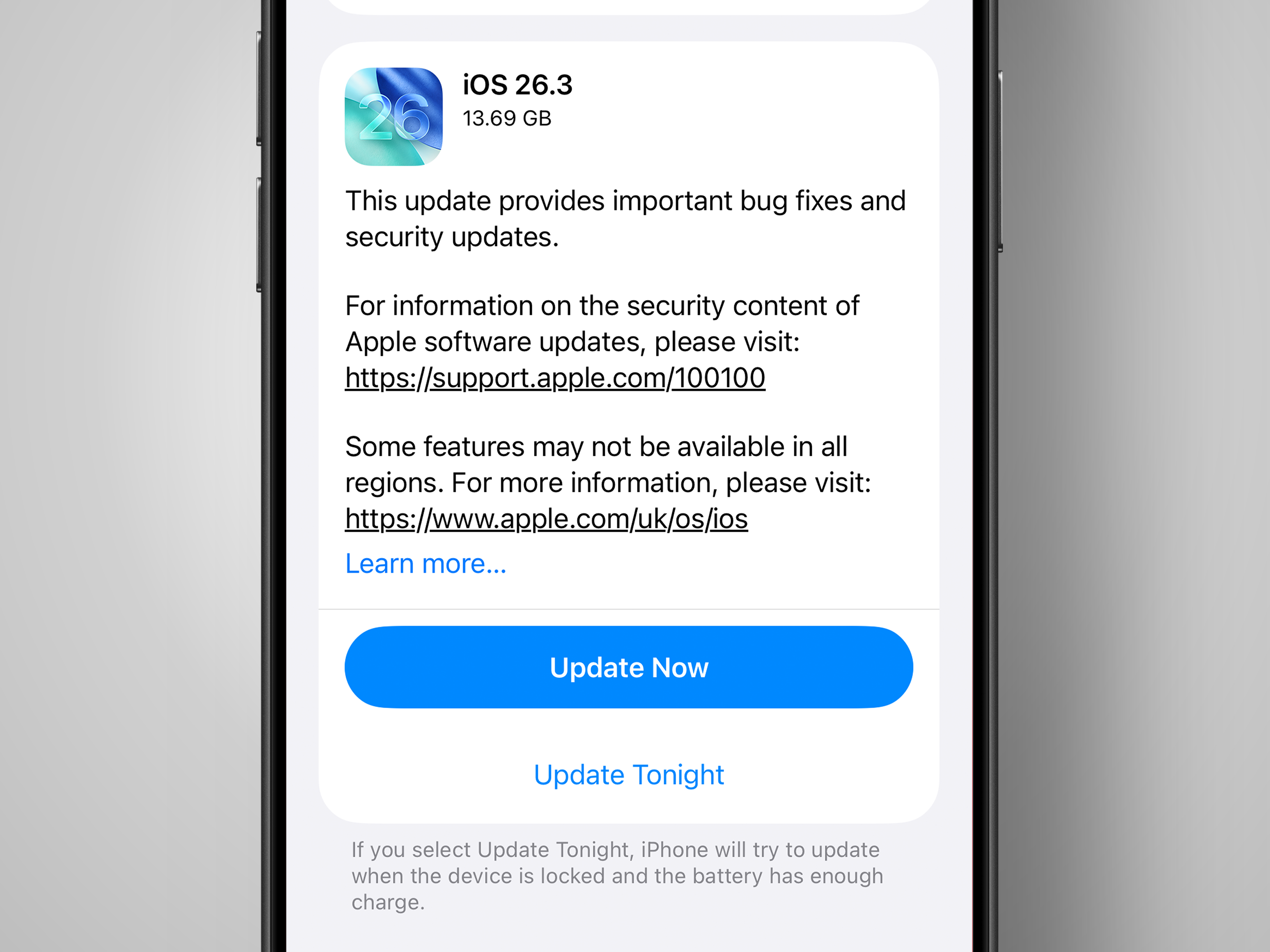
Apple's latest software update landed this week with very little fanfare, and honestly, that's understandable. iOS 26.3 is not a blockbuster release. There are no major design changes, no headline new apps, and nothing that's going to make you gasp when you unlock your phone. But before you file it under "I'll get round to it later," there are a few things worth knowing about, and one very good reason to install it now.
Let's start with the most interesting new addition. iOS 26.3 introduces a built-in Transfer to Android tool, which does exactly what the name suggests. If you ever want to move from an iPhone to an Android device, you can now do it natively through Settings without needing a third-party app. Place your iPhone next to your new Android phone, and it'll wirelessly transfer your photos, messages, notes, apps, passwords, and even your phone number. Health data and Bluetooth-paired devices won't make the journey, but for most people, the essentials are covered. This has been built as a joint effort between Apple and Google, and Google is working on a matching feature for going in the opposite direction. It's a surprisingly generous move from Apple, though it's worth noting that EU regulations around interoperability have played a significant role in making it happen.
Speaking of the EU, there are a handful of Europe-only changes in this update too. Apple has been testing a Notification Forwarding feature that would let third-party wearables like Android smartwatches display your iPhone notifications, putting them on a more level playing field with the Apple Watch. That feature appeared in the beta but didn't make it into the final release, so expect it to arrive in a future update instead. There's also support for proximity pairing for third-party accessories, which would let headphones and other devices pair with your iPhone in the same quick, one-tap way that AirPods do. Again, this is an EU-only change driven by Digital Markets Act compliance, but it's the kind of thing that arguably should exist everywhere.
On the privacy front, iOS 26.3 introduces a new setting called Limit Precise Location. This restricts the location data that your mobile network can access, so instead of knowing your exact street address, your carrier would only be able to determine your general neighbourhood. It's a small but genuinely welcome privacy improvement. The catch is that it only works on devices with Apple's own C1 or C1X modems, which currently means the iPhone 16e and iPhone Air. And carrier support is limited too. In the UK, EE and BT support it, with Boost Mobile in the US and Telekom in Germany also on board. It's early days, but the groundwork is there for this to become more widely available over time.
The wallpaper gallery has had a minor tweak as well. The Weather and Astronomy categories, which were previously bundled together, are now split into their own separate sections. Apple has also added a few new pre-configured Weather wallpapers with different clock fonts and widget arrangements. It's nothing revolutionary, but it does make the wallpaper picker a bit easier to browse, and the live Weather wallpapers remain one of my favourite little touches on the Lock Screen.
Now, the part that matters most, and the reason I'd encourage you to update sooner rather than later. iOS 26.3 includes fixes for over 35 security vulnerabilities, including one that Apple describes as having been exploited in what it calls an "extremely sophisticated attack" against targeted individuals. That vulnerability, found in the dyld dynamic link editor, could allow an attacker to execute arbitrary code on your device. It was discovered by Google's Threat Analysis Group and has been used in real-world attacks. There are also three kernel-level fixes, one of which could allow a malicious app to gain root access to your device, and a bug in Photos that could let someone view your images from the Lock Screen. None of this is the kind of thing that should keep you up at night, but it does mean this update is not one to skip.
So yes, iOS 26.3 is a quiet update. It's not going to change the way you use your iPhone. But between the security fixes, the new privacy controls, and the Transfer to Android tool, there's more going on here than first meets the eye. And with iOS 26.4 now on the horizon, bringing with it the first wave of new Siri features and the start of Apple's Gemini-powered AI push, this feels very much like the calm before the storm.
Tip of the week
Did you know, iOS 26 includes a smart new feature called Lens Cleaning Hints that analyses incoming light to detect if your camera lens is smudged, popping up a quick on-screen alert so you never ruin a great photo with a dirty lens?
Here is how you can easily enable it on your iPhone:
-
Open the Settings app.
-
Scroll down and tap on Camera.
-
Toggle on Lens Cleaning Hints.