This week, Apple brings blood oxygen back to the Watch, rumours around a cheap MacBook and the next Pro iPhone continue, and we get our clearest look yet at the product roadmap...
Blood Oxygen returns to Apple Watch... kind of
After months of legal wrangling, Apple has now found a workaround to bring blood oxygen monitoring back to the Apple Watch, although not in the way you might expect.

From this week, Apple is rolling out a software update that essentially redesigns how blood oxygen readings are processed. Rather than being measured and displayed directly on your wrist, the data will now be sent over to your iPhone, where it will be calculated and displayed in the Health app under the Respiratory section.
So yes, you’ll get your blood oxygen data back, but you’ll need to grab your phone to see it.
This update applies only to Apple Watch Series 9, Series 10, and Ultra 2 models sold after January 17th, 2024 - the date the US import ban from the International Trade Commission took effect. Older watches (or those purchased outside the US) are unaffected and still include the original on-watch experience. You can check if your device falls under the redesign by looking for a serial number that ends in LW/A.
To enable the feature, you’ll need to update to watchOS 11.6.1 and iOS 18.6.1.
This all stems from Apple’s long-running legal battle with Masimo, a medical tech firm best known for its pulse oximeters. Masimo sued Apple back in 2020, accusing them of patent infringement and stealing trade secrets. That eventually led to the ITC ruling, and Apple’s subsequent workaround. The legal fight is still ongoing, and Apple has responded by filing its own lawsuits against Masimo, accusing them of cloning the Apple Watch and fighting back with a 916-page appeal of the ITC’s decision.
Masimo’s relevant patents are due to expire in 2028, so this workaround is likely a stopgap, but a clever one. It’s not quite the return of blood oxygen on the wrist just yet, but it’s a step in that direction.
More details emerge about that budget MacBook
We’re starting to get a clearer picture of Apple’s upcoming entry-level MacBook, something I’ve mentioned in the newsletter previously as one of the more interesting devices on Apple’s longer-term roadmap.

According to a new report from Taiwanese supply chain publication DigiTimes, the lower-cost MacBook is expected to arrive with a 12.9-inch display and will run on a version of the A18 Pro chip that debuted in the iPhone 16 Pro models last year. If that turns out to be accurate, it would be the first time Apple has used an A-series chip from the iPhone inside a Mac, which would be a pretty big deal in terms of how Apple structures its hardware lineup.
Pricing is thought to start between $599 and $699 in the US, with a potential launch window in late 2025 or early 2026. At that kind of price, it would be a clear play to compete against Chromebooks and budget Windows laptops, especially in the education market.
Well-known supply chain analyst Ming-Chi Kuo was the first to talk about this new MacBook, and many of his details match the DigiTimes report. He says the device will come in bright colours like silver, blue, pink and yellow, borrowing some of the colour energy from the current iMac range. It’s expected to have a thin, lightweight design, likely resembling the discontinued 12-inch MacBook from a few years back, and it would sit below the MacBook Air in the lineup.
In terms of performance, the A18 Pro chip has a 6-core CPU, 6-core GPU and a 16-core Neural Engine. It’s around 40% slower than the M4 chip, but still comparable to the original M1, which Apple sold in the MacBook Air for a number of years. In fact, that old M1 MacBook Air is still being sold through retailers like Walmart for $599, so this could act as a spiritual successor, with better battery life and improved efficiency thanks to the newer chip.
There are a few compromises to be aware of. For example, RAM is expected to be 8GB, rather than the 16GB minimum found in current MacBook models. It also won’t support Thunderbolt, so data transfer speeds will be capped at 10 Gb/s, and the laptop may only support a single external display natively. That said, this limitation could be worked around using DisplayLink adapters if needed.
If you’re looking for a Mac and don’t need pro-level specs, this could be a really solid option — and one that opens the door to more users entering the Apple ecosystem without needing to spend $1,000 or more. Apple often releases new Macs in October, so it’ll be interesting to see if they decide to preview it then or save it for early next year. Either way, I’ll be watching this one closely.
Enjoy tips videos, but struggle to remember everything?
Then you should definitely take a look at iPhone Essentials Plus. It’s my dedicated iPhone training portal with more than 150 lessons covering every aspect of your device, and I’m adding new content all the time.

Each lesson includes a short video, a step-by-step guide with screenshots, and a downloadable PDF, so no matter how you like to learn, you’re sorted. There are no ads, no sponsors, just straight-up content, and it’s all available for a one-time payment, no subscription.
And if you’re a Mac user, I’ve just launched a Mac version too. You can pick that up on its own or bundle it with the iPhone course to get the best value. If you’re interested, click the links below to get started.
Also - If you've already purchased, you're going to begin to see a LOT of OS 26 content being added in the coming weeks. I'm adding it to separate sub-modules. So for example, in the Notes section of the iPhone course, there will be 4 sub-modules;
- Fundamentals (iOS 18)
- Fundamentals (iOS 26)
- Next Steps (iOS 18)
- Next Steps (iOS 26)
This way, the new content should be live in full, by the time the software arrives, but you can still enjoy relevant content in the meantime. Also, if you don't update your software right away, I plan on leaving the iOS 18 content for a good while, so there's no rush as far as the content is concerned. The same applies for the Mac content.
Purchase Links;
- iPhone Essentials Plus
- Mac Essentials Plus
- iPhone & Mac Essentials Plus Discount Bundle
- iPhone & Lifetime PDF
- Mac & Lifetime PDF
- iPhone, Mac & Lifetime PDF
New leak reveals iPhone 17 Pro redesigned chassis
With the launch of the iPhone 17 range now only a few weeks away, the leaks are coming thick and fast. The latest rumour gives us our best look yet at what could be a major redesign of the iPhone 17 Pro’s chassis, with a shift away from titanium and a return to a more familiar material: aluminium.

According to a new leak shared by MacRumors, the iPhone 17 Pro will feature a completely redesigned back panel, with a fresh approach to how Apple blends glass and aluminium. The device looks to have a single piece of aluminium that curves gently up the sides of the phone, meeting a thinner slab of rear glass. Visually, it’s a big departure from the flat-backed titanium design we’ve seen on recent Pro models.
The aluminium appears to be anodised with a matte finish, rather than the polished, mirror-like surface seen in some earlier iPhones. The result is something that looks softer and more comfortable to hold, and there’s a definite feeling that this design borrows a little from the look of the Vision Pro. That wouldn’t be surprising, given Apple’s ongoing push for cohesive design across its product lines.
One thing that really stands out is the larger and more pronounced camera bump, with a big rectangular island housing the triple-lens system and LiDAR scanner. It’s not yet clear if this means major camera hardware upgrades, but it does support earlier reports that suggested dual telephoto lenses and improved zoom for the Pro Max model.
There’s also been some speculation that Apple’s decision to return to aluminium isn’t just about design. It could help lower production costs, which might allow the company to invest more in things like larger batteries, enhanced displays, or AI-focused chip architecture.
Of course, all of this is still rumour at this stage, and it’s worth treating the leak with some caution. But when you combine it with recent reports about new colour options like copper orange and deep blue, it certainly seems that Apple is planning a distinctive visual refresh for its most premium iPhone.
We won’t have long to wait. If current timelines hold, the official reveal should be happening in early September.
Apple Code Leak Points to New Vision Pro, iPads, HomePod and More
It looks like Apple’s software team has once again revealed more than they perhaps intended, with fresh code leaks pointing to a wave of upcoming product refreshes across nearly every major hardware category. These kinds of leaks have been happening more frequently in recent years, and if what’s been uncovered this time turns out to be accurate, it could give us our clearest roadmap yet of Apple’s next few months.
The latest findings come from Apple’s own backend databases, where references have been found to a range of unannounced product identifiers. This includes what appears to be an all-new Vision Pro model, new iPads, an updated HomePod, a refreshed Apple TV, and even a second-generation Studio Display.
Starting with the Vision Pro, the new identifier suggests that Apple may be preparing to release a second Vision headset earlier than expected. We’ve heard plenty of rumours about a more affordable or lighter version of the Vision Pro, possibly with fewer sensors or a tethered setup, but it’s been unclear when that would arrive. This new code listing hints that development is further along than previously thought.
On the iPad front, the software refers to three new models, which could line up with updates to the entry-level iPad, iPad mini and iPad Air. While the Pro line was refreshed earlier this year, the rest of the iPad range is due for an update, and Apple will no doubt want to align these with the rollout of iPadOS 26 this autumn.
Interestingly, there’s also mention of a new HomePod. The current HomePod and HomePod mini haven’t seen meaningful upgrades in a while, and this could be Apple’s next step toward the long-rumoured smart home hub. This is something I’ve talked about previously here in the newsletter, with Apple expected to merge elements of the iPad and HomePod into a single countertop device. Whether this new listing points to that exact product or simply a spec bump for the existing HomePod is still unknown.
Also spotted was a reference to a new Apple TV, which aligns with other reports suggesting a budget-friendly model might arrive later this year. The current Apple TV 4K is now three years old, so an update makes sense, particularly if Apple wants to keep pace with cheaper streaming devices and push further into continuity camera and gaming support.
Finally, the leak includes a product identifier that strongly suggests a second-generation Studio Display is on the way. The current model, while beautifully built, has been criticised for its outdated webcam and A13 chip. A refresh with a newer panel and better internal components would go a long way to keeping Apple competitive in the pro display market.
Of course, leaked product identifiers don’t always guarantee an imminent launch, but Apple rarely adds these into the codebase unless something is getting close to release. With a packed September ahead and more events likely in October, we could be looking at one of the busiest autumn product cycles for Apple in years.
Tip of the week
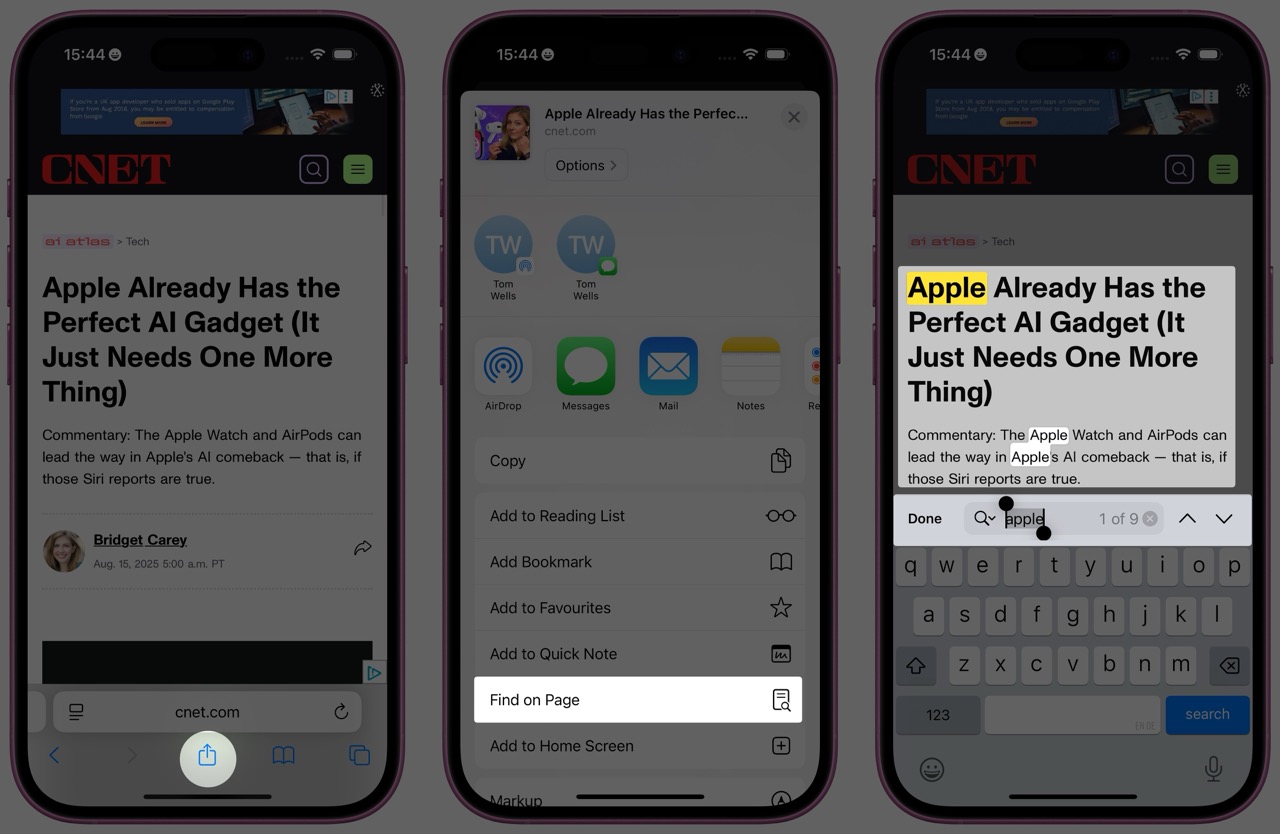
Did you know you can search directly within any webpage in Safari on your iPhone?
-
Open Safari and go to the webpage you want to search.
-
Tap the Share button.
-
Scroll down and tap Find on Page.
-
Type your search term, then use the arrows to jump between matches.
My new content
Are YOU charging your iPhone correctly?
|
Content I've enjoyed
Apple's new plan for AI
|

Apple's AI comeback
|

This thing looks INCREDIBLE
|